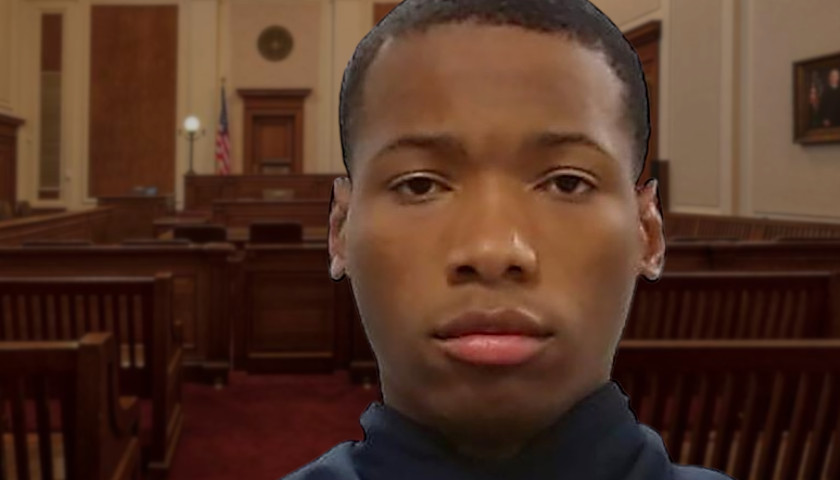
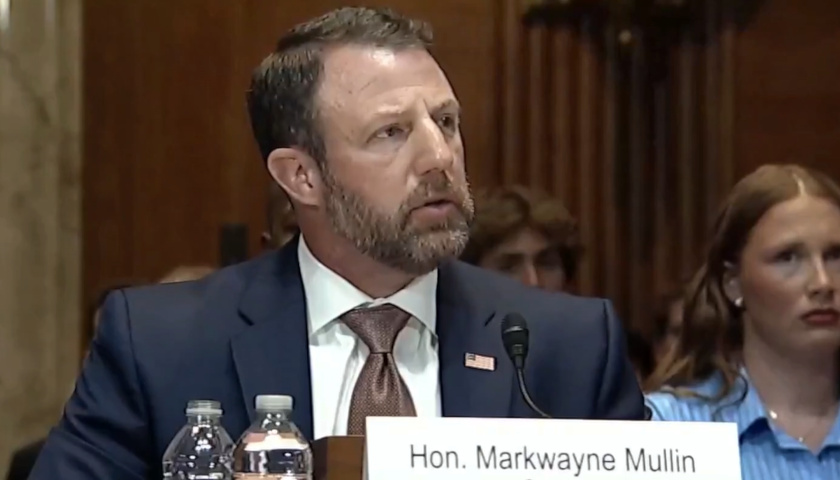
Tom Pappert, lead reporter at The Tennessee Star, said remarks made by U.S. Department of Homeland Security (DHS) Secretary Markwayne Mullin during a Senate Appropriations Committee hearing this week could significantly alter the legal landscape surrounding Kilmar Abrego Garcia
During an appearance Friday on The Michael Patrick Leahy Show, Pappert explained how the development emerged during an exchange between Mullin and Maryland U.S. Senator Chris Van Hollen (D-MD), who questioned the secretary about where Abrego Garcia could ultimately be deported.
After Van Hollen asserted that Costa Rica had agreed to accept Abrego Garcia and that he had agreed to be removed there, Mullin responded, “Great. If he’s willing to do that, we’ll be happy to send him.”
Pappert characterized the statement as a major shift in DHS policy.
“What you just heard was DHS Secretary Markwayne Mullin say, for the first time that anybody at his agency has, that Kilmar Abrego Garcia may be deported to Costa Rica,” Pappert said. “Not Liberia, not Eswatini, not any of the African nations that the DOJ and DHS have been arguing, in conjunction with the State Department, to obtain diplomatic assurances that Abrego Garcia should be returned to.”
Pappert explained that the reference to Costa Rica dates back to plea negotiations in the federal human smuggling case against Abrego Garcia.
“Abrego Garcia, when charged with human smuggling, was in the middle of negotiating a plea that would have seen him serve a small amount of jail time, plead guilty to one charge, and in exchange, the U.S. Department of State obtained diplomatic assurances from the government of Costa Rica saying that he would be treated humanely, he would be granted citizenship residence or visitor status within the country, and most importantly to his attorneys, Abrego Garcia would not be returned to El Salvador,” Pappert said.
However, Pappert noted that Abrego Garcia ultimately declined the proposed plea agreement.
“But Abrego Garcia decided he did not want to sign that plea deal,” Pappert said. “In fact, it seems his immigration attorneys merely cited the existence of Costa Rica’s diplomatic assurances as evidence that he should be deported there.”
Pappert also highlighted what he described as a contradiction between Mullin’s remarks and the Department’s prior position, pointing to a recent decision by acting ICE Director Todd Lyons rejecting Abrego Garcia’s request to be deported to Costa Rica.
“It was just weeks ago that ICE Acting Director Todd Lyons signed the document that formally notified Abrego Garcia the Trump administration was disregarding his desire to be deported to Costa Rica, saying that it would harm the diplomatic standing of the United States, which has worked with Liberia and other African countries,” Pappert said.
He went on to suggest that if Mullin’s statement becomes formal DHS policy, it could accelerate resolution of several ongoing legal disputes.
“Should this go through, should Markwayne Mullin’s statement in the Senate earlier this week become the official policy of the DHS, it seems as though this is going to solve a lot of the outstanding arguments before Judge Paula Xinis, as well as the Fourth Circuit Court of Appeals,” Pappert said.
He noted that attorneys representing Abrego Garcia have already submitted Mullin’s remarks to the court as evidence in support of their position that Costa Rica is the proper destination for removal.
“Abrego Garcia’s attorneys have asked for a judgment, a ruling that states the only place Abrego Garcia can be deported is to Costa Rica,” Pappert said. “They have already, since Markwayne Mullin made the statement on Tuesday, added this to their repertoire of evidence.”
Pappert argued that the administration’s apparent willingness to reconsider Costa Rica could bring the years-long case closer to an end.
“If the Trump administration is no longer fighting this though, then it seems to me we could be on a rapid path toward the resolution of the Abrego Garcia story that has been ongoing, really, since 2019,” he said.
During Friday’s show, Pappert also disputed several claims made by the Maryland senator regarding the federal criminal case against Abrego Garcia.
Addressing the timeline of the human-smuggling indictment, Pappert said, “He was indicted by a grand jury. It was a sealed indictment that was only unsealed on, I believe we’re coming up on the one-year anniversary. It was last June when Abrego Garcia was actually returned.”
Pappert further stressed that the criminal investigation originated from reporting by The Star concerning a 2022 Tennessee Highway Patrol traffic stop involving Abrego Garcia.
“There was a former special agent at Homeland Security Investigations … and then, of course, the prosecutor himself,” Pappert said. “Both of these people testified essentially … that, yes, the case started when they came across reporting from the Tennessee Star.”
With regard to the recent dismissal of the human-smuggling charges, Pappert criticized U.S. District Judge Waverly Crenshaw’s ruling that the prosecution was presumptively vindictive.
“The judge determined that even though there was no evidence of actual vindictive prosecution, the Trump administration DOJ had failed to rebut the presumption of vindictiveness,” Pappert said.
Tune in now to The Michael Patrick Leahy Show – your AMERICA FIRST news talk!
– Watch LIVE here on X
– Watch LIVE on YouTube / Rumble / Roku / AppleTV
– Listen on Spotify
– Listen on WENO AM760 in Nashville
– Read more at @TheTNStar https://t.co/honZxxcGUU— Michael Patrick Leahy (@michaelpleahy) June 5, 2026
– – –
Kaitlin Housler is a reporter at The Tennessee Star and The Star News Network.